java7排序和java8函数式排序区别
//java7
  @Test
  public void sort() {
    List<Integer> list = Arrays.asList(232, 4, 25, 23, 7, 48, 9);

      Collections.sort(list, new Comparator<Integer>() {
          @Override
          public int compare(Integer t1, Integer t2) {
              return t2.compareTo(t1);
          }
      });

      for (Integer integer : list) {
          System.out.println(integer);
      }
  }
//java8
  @Test
  public void sort() {
    List<Integer> list = Arrays.asList(232, 4, 25, 23, 7, 48, 9);

//    list.sort(Comparator.naturalOrder());
    list.sort(Comparator.reverseOrder());

    list.forEach(System.out::println);
  }
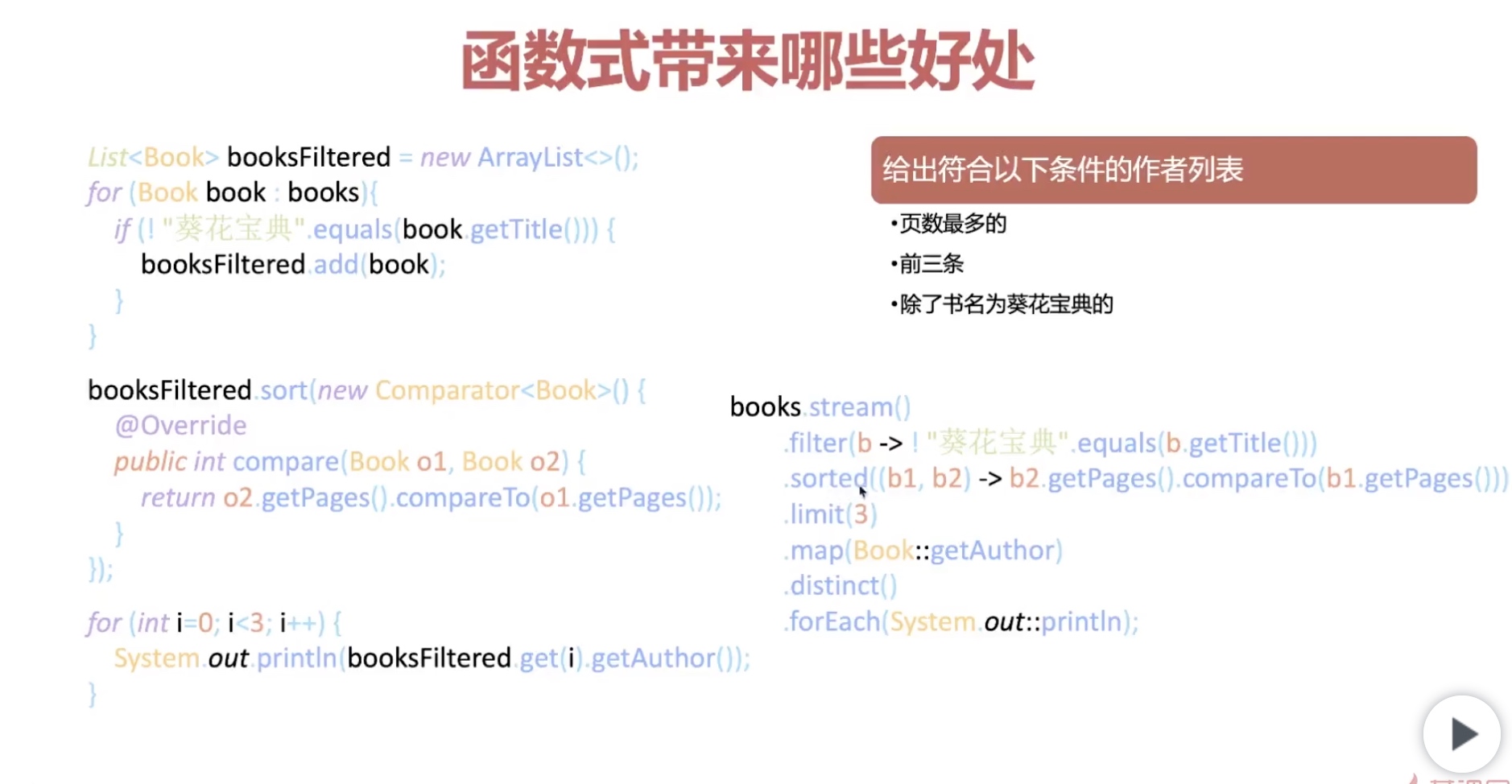
@Test
public void givenListOfBooks_thenExplainTheAdvantageOfFunction() {
    String authorA = "张三";
    String authorB = "李四";
    String authorC = "王五";
    String authorD = "前朝太监";
    List<Book> books = Arrays.asList(
            new Book("C++编程", authorA, 1216),
            new Book("C#编程", authorA, 365),
            new Book("Java编程", authorB, 223),
            new Book("Ruby编程", authorB, 554),
            new Book("21天精通Python", authorB, 607),
            new Book("21天精通Go", authorC, 352),
            new Book("葵花宝典", authorD, 1200),
            new Book("编程圣经", authorA, 320)
    );
    List<Book> booksFiltered = new ArrayList<>();
    for (Book book : books){
        if (! "葵花宝典".equals(book.getTitle())) {
            booksFiltered.add(book);
        }
    }
    booksFiltered.sort(new Comparator<Book>() {
        @Override
        public int compare(Book o1, Book o2) {
            return o2.getPages().compareTo(o1.getPages());
        }
    });
    for (int i=0; i<3; i++) {
        System.out.println(booksFiltered.get(i).getAuthor());
    }
    // 函数式
    books.stream()
            .filter(b -> ! "葵花宝典".equals(b.getTitle()))
            .sorted((b1, b2) -> b2.getPages().compareTo(b1.getPages()))
            .limit(3)
            .map(Book::getAuthor)
            .distinct()
            .forEach(System.out::println);
}
distinct 去重